

Have you ever wished for a tool that, without the need for complicated therapy sessions or medication, could reduce anxiety, calm your body, and bring you peace? Imagine doing a quick, safe, and surprisingly powerful exercise before a big meeting, at work, or at home. Emotional Freedom Techniques (EFT) provide just that.
By simply tapping on certain points on your body, EFT, also known as “tapping therapy,” is a gentle yet effective technique that helps you release emotional blockages, lower stress levels, and regain inner harmony. EFT connects the mind and body to facilitate internal healing. It has its roots in traditional Chinese acupressure and is supported by contemporary psychology.
EFT offers a self-empowering, scientifically validated technique to help you recover your composure and overcome emotional distress, regardless of whether you are dealing with anxiety, phobias, chronic pain, past trauma, or even low self-worth. Let us examine how this easy technique can result in mental, physical, and emotional transformations.
Gary Craig created the mind-body healing method known as EFT (Emotional Freedom Techniques) in the 1990s. EFT is fundamentally predicated on the notion that emotional distress upsets the body’s energy system and that we can release blocked energy, lessen emotional intensity, and create emotional freedom by tapping on specific acupressure points.
It functions similarly to emotional acupuncture, but without the use of needles. Instead, you focus on a particular emotion, memory, or belief while lightly tapping on particular energy meridian points with your fingertips, primarily on the hands, face, and upper body. This tapping helps to balance out the emotional impact of what you are talking about by sending soothing signals to the brain.
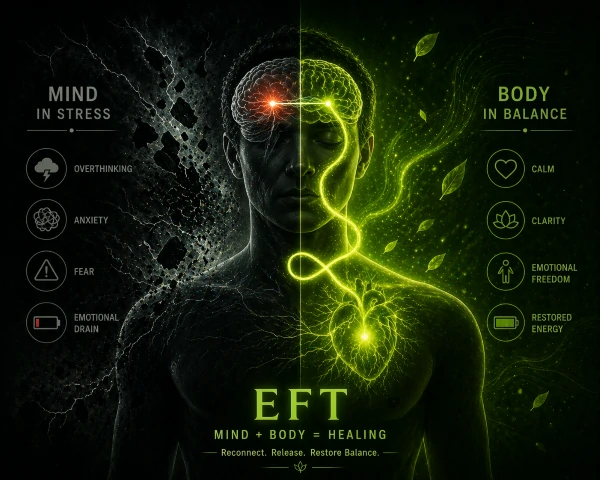
EFT combines self-awareness with physical tapping in a methodical but simple-to-learn sequence. Here is a basic synopsis:
1. Determine the problem
Start by deciding on a specific issue that you want to address. This issue could be a limiting belief, stress, anxiety, fear, or physical symptoms.
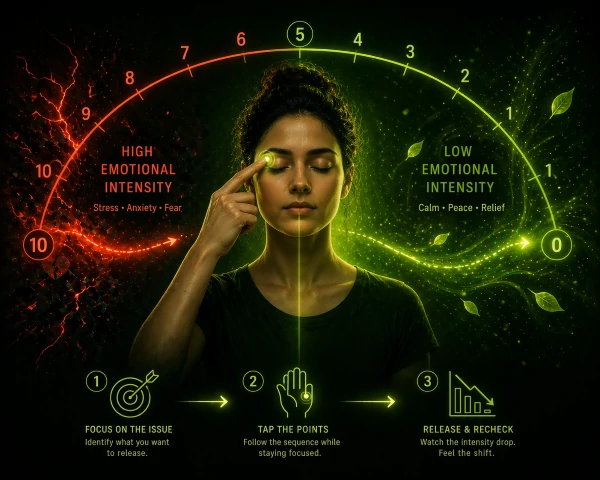
2. Evaluate the level of intensity
On a scale of 0 to 10, you indicate how strongly you experience the emotion or discomfort. This aids in monitoring your development.
3. Configure the “Setup Statement.”
You say something like, “Even though I feel this anxiety, I deeply and completely accept myself,” while tapping on the karate chop point, which is the side of your hand.
This makes room for change and fosters psychological acceptance.
4. Press the sequence.
You make a series of meridian points with your fingertips:
– The crown of the head
– The eyebrow
– The eye’s side
– Beneath the eye
– Beneath the nose
– Chin
– The collarbone
– Under the arm
To keep your attention on the problem, you repeat a reminder phrase while tapping, such as “this anxiety.”
5. Reevaluate the level of intensity
You tap once or more times and then check in once more. Has the intensity of the emotions decreased? It frequently drastically declines or even disappears.
Therapists, coaches, and individuals from all over the world have utilized EFT to treat a wide range of emotional and physical problems. Among its most popular uses are:
– Reduction of stress and anxiety
– Social anxiety or panic attacks
– Phobias and fears (such as heights, public speaking, and flying)
– PTSD and emotional trauma
– Issues with confidence and low self-esteem
– Anger, guilt, or grief
– Anxiety about performance in sports, tests, and the workplace
– Emotional eating and cravings
– Insomnia or problems sleeping
– Conditions linked to tension and chronic pain
In the treatment of chronic illnesses and trauma, EFT is also becoming more and more well-liked as a supplemental strategy, particularly for patients dealing with stress-related illnesses like cancer, autoimmune diseases, or fatigue syndromes.
EFT was formerly regarded as “alternative,” but research is now supporting it more and more. Research has indicated that EFT:
– Lowers the stress hormone cortisol levels.
– Controls the brain region responsible for fear reactions, the amygdala.
– Enhances heart rate variability, a crucial indicator of the health of the nervous system.
– Reduces the symptoms of PTSD, anxiety, and depression in both short- and long-term follow-ups
– EFT is successful in lowering anxiety in a variety of populations, according to a 2019 meta-analysis that was published in the Journal of Evidence-Based Integrative Medicine.
This increasing amount of scientific proof validates what many people already know: EFT is effective.
EFT is unique because it is both empowering and easy to use. To gain from it, you don’t have to be an expert or therapist. Anyone can learn EFT and apply it whenever they feel overburdened, stuck, or emotionally unbalanced with a little practice.
– People adore EFT for the following reasons:
– There are no needles, pills, or adverse effects, making it non-invasive.
– It’s quick; sometimes, just one round can completely change your emotional state.
– It’s private; you can do it by yourself, anywhere, at any time.
– It addresses a problem’s emotional and physical components, making it holistic.
– It is trauma-sensitive; discussing traumatic events in detail is not necessary.
EFT gives people the ability to literally take emotional healing into their own hands, whether they choose to use it as a daily self-care routine or as a component of a guided healing journey.
All of us bear emotional scars from stress, the past, and future anxiety. EFT provides a soft, approachable way to recognize those feelings, let them go, and regain emotional clarity, balance, and calm.
Therefore, keep in mind that you have the ability to access peace the next time anxiety or self-doubt start to creep in. All you need are your own hands, a few minutes of solitude, and the courage to be honest with yourself.